
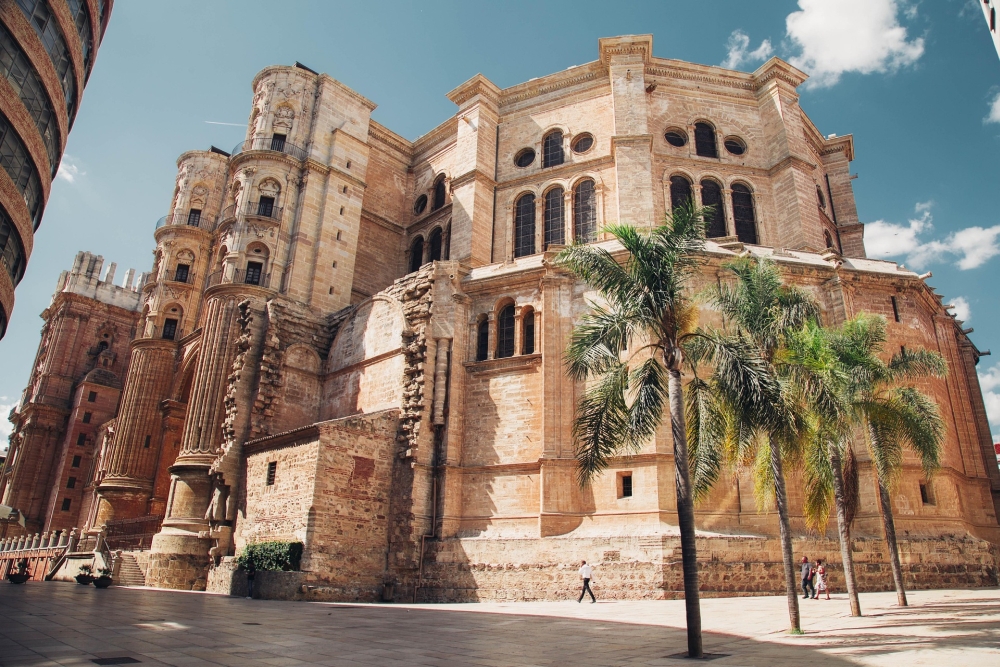
Málaga spent years being treated as just the airport gateway to the Costa del Sol, a place tourists passed through on the way to Marbella or Nerja rather than a destination in its own right. That’s changed — the city’s historic center now holds Roman ruins, a Moorish fortress, and Picasso’s actual birthplace within a fifteen-minute walk of each other. Sightseeing in Málaga works best when you treat the compact old town as a single half-day loop and reserve separate time for the coastline and day trips, since the city’s real draw is how much history sits stacked in one small area. Here’s what’s actually worth your time, current 2026 prices, and how the pieces fit together.
Alcazaba and Gibralfaro: Málaga’s Moorish skyline
The Alcazaba, an 11th-century Moorish fortress-palace, sits directly above the city’s Roman theatre and dominates Málaga’s skyline from nearly every angle in the old town. General admission costs €3.50, and the fortress is genuinely one of the best-value monuments in Spain — a combined ticket with Gibralfaro Castle, the hilltop fortification 20 minutes further uphill, costs €5.50. Both sites offer sweeping views over the port, cathedral, and Mediterranean that rank among the best in the city at any price.
Summer hours (April 1 to October 31) run 9:00 AM to 8:00 PM, with winter hours (November to March) closing at 6:00 PM; last entry is roughly 45 minutes before closing. The two monuments aren’t internally connected — Gibralfaro requires either the uphill walk or Bus 35 from Paseo del Parque — so budget separate time blocks rather than expecting to move between them quickly.
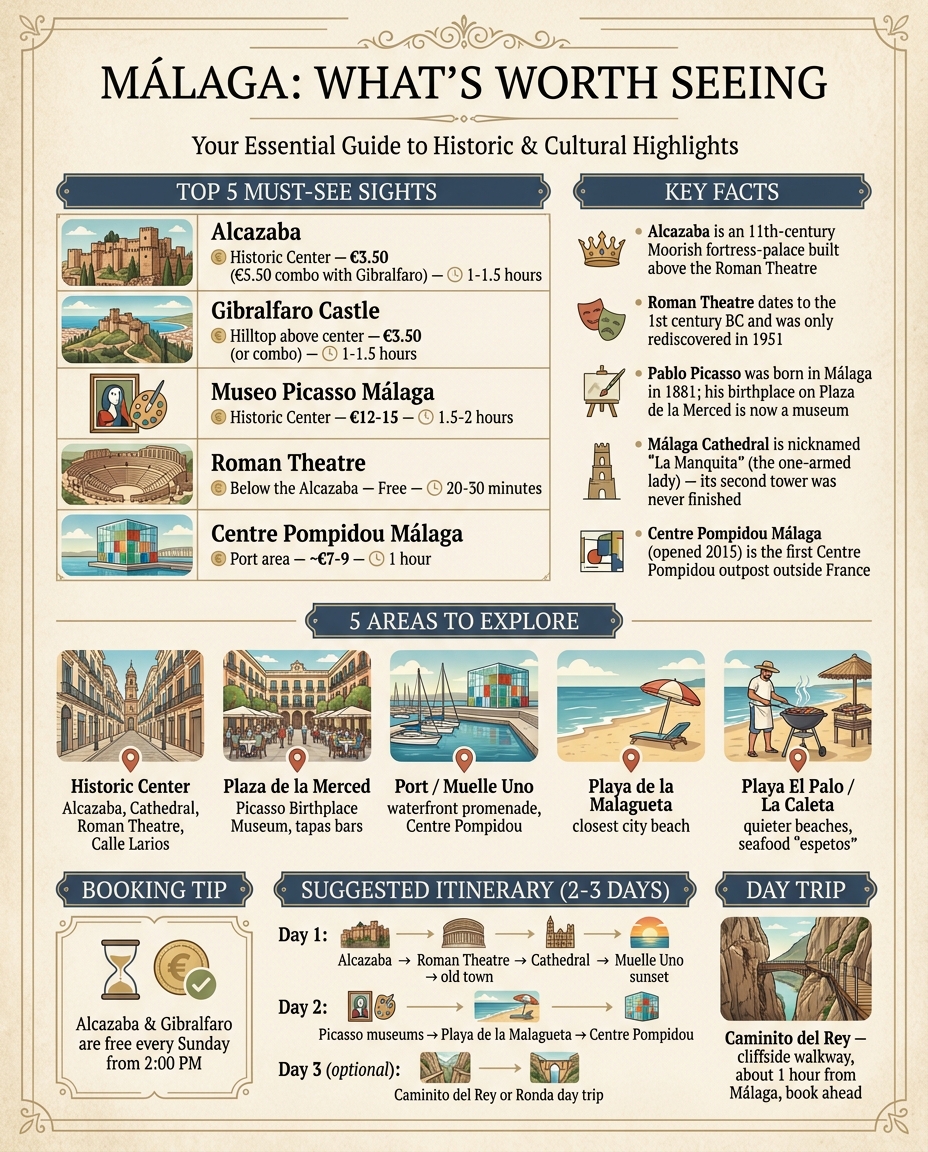
Both the Alcazaba and Gibralfaro Castle offer free entry every Sunday from 2:00 PM onward, a detail most visitors never learn from paid tour operators.
Picasso’s Málaga: two museums, one birthplace
Pablo Picasso was born in Málaga in 1881 and, while he left as a teenager and never permanently returned, the city has built a significant part of its cultural identity around the connection. The Museo Picasso Málaga, housed in the 16th-century Buenavista Palace, holds around 285 of his works donated by family members and runs standard entry at roughly €12-15 with an included audio guide, with timed entry slots split across morning, midday, and afternoon shifts.
Separately, the Picasso Birthplace Museum on Plaza de la Merced — an official heritage site since 1983 — preserves the actual apartment where he was born, offering a more intimate, personal counterpoint to the art-focused main museum. Visiting both in one day is common and easy, since they’re a five-minute walk apart in the same historic quarter.
Málaga Cathedral and the Roman Theatre
Locally nicknamed “La Manquita” (the one-armed lady) because its second bell tower was never completed — funds were reportedly diverted to support the American Revolutionary War in the 18th century — the Málaga Cathedral combines Renaissance and Baroque elements built over nearly 250 years of construction. Directly at its base sits the Roman Theatre, dating to the 1st century BC and rediscovered only in 1951 during construction work, making it one of the more recent major archaeological finds in a European city center; entry is free and it takes no more than 20-30 minutes to see properly.
Centre Pompidou Málaga and contemporary art
Housed in a distinctive glass cube structure on the harbourfront, the Centre Pompidou Málaga is the first satellite outpost of Paris’s Centre Pompidou outside France, opened in 2015 as part of the city’s broader push to diversify beyond beach tourism. It’s a useful contrast to the historic sights nearby — rotating contemporary exhibitions paired with a permanent collection drawn from the Paris institution’s holdings.
Calle Larios and the old town core
Running from Plaza de la Constitución toward the port, Calle Larios is Málaga’s main pedestrian shopping street and, during the December feria and Christmas season, one of the most elaborately lit streets in Spain. The surrounding grid of narrow streets — Plaza de la Merced, where Picasso’s birthplace sits, and the tapas bars along Calle Granada — rewards unhurried wandering more than a fixed checklist, similar to Barcelona’s Gothic Quarter but on a smaller, more walkable scale.
Comparing the major sights
| Attraction | Area | Entry (2026) | Time needed |
|---|---|---|---|
| Alcazaba | Historic center | €3.50 (or €5.50 combo) | 1-1.5 hours |
| Gibralfaro Castle | Hilltop above center | €3.50 (or combo) | 1-1.5 hours |
| Museo Picasso Málaga | Historic center | €12-15 | 1.5-2 hours |
| Roman Theatre | Below the Alcazaba | Free | 20-30 min |
| Centre Pompidou Málaga | Port area | ~€7-9 | 1 hour |
Beaches and the port promenade
Playa de la Malagueta, the closest beach to the old town, sits a 15-minute walk from the cathedral and gets busy but stays convenient for a few hours between sightseeing blocks. Further east, Playa El Palo and Playa de la Caleta offer a quieter, more local alternative with better beachside seafood restaurants (chiringuitos) serving grilled sardines skewered on cane spits, a Málaga specialty called espetos. The renovated Muelle Uno port promenade connects the old town directly to the waterfront and Centre Pompidou, making it easy to combine a harbor walk with museum time on the same afternoon.
Day trips: Caminito del Rey and beyond
The Caminito del Rey, a walkway pinned roughly 100 meters up a gorge wall near El Chorro, about an hour from Málaga, has become one of Andalusia’s most popular day trips since its 2015 renovation replaced the original crumbling early-1900s path. Guided day tours including transport typically run €75-90, and the walk itself takes around 3 hours; booking ahead is essential since capacity is capped and popular dates sell out.
Other common day trips include Ronda, a dramatic clifftop town split by a deep gorge and one of Spain’s oldest bullfighting rings, and Nerja, known for its coastal caves and the Balcón de Europa viewpoint. Both are commonly bundled into full-day guided tours from Málaga running roughly €35-80 depending on inclusions.
How to plan the days
Two full days cover Málaga’s core sights comfortably: day one for the Alcazaba, Roman Theatre, cathedral, and old town wandering, finishing at Muelle Uno for sunset; day two split between the Picasso museums in the morning and Playa de la Malagueta or Centre Pompidou in the afternoon. A third day opens up either Caminito del Rey or a day trip to Ronda, both of which require a full day given travel time. Unlike Barcelona, Málaga’s center is compact enough to cover almost entirely on foot — most of the sights above sit within a 15-20 minute walk of each other, making it one of the easier Spanish cities to sightsee without relying on public transport.
Frequently Asked Questions
How many days do you need to see Málaga properly?
Two days cover the historic center’s essential sights comfortably; a third day allows for a day trip to Caminito del Rey or Ronda without rushing the city itself.
Is the Alcazaba worth visiting if you’re also going to Gibralfaro Castle?
Yes — the combined ticket at €5.50 covers both and they offer different perspectives on the city, though the two sites aren’t internally connected, so plan separate time for each.
Which Picasso museum should you visit if you only have time for one?
The Museo Picasso Málaga offers the larger art collection and is the better choice for seeing his actual work, while the Picasso Birthplace Museum is a shorter, more personal stop worth adding if time allows.
Do you need to book Caminito del Rey tickets in advance?
Yes — daily capacity is capped, and guided tours from Málaga, which include transport, regularly sell out on popular dates, so booking at least several days ahead is recommended.
Is Málaga walkable, or do you need public transport to see the main sights?
Málaga’s historic center is compact enough to cover almost entirely on foot, with most major sights within a 15-20 minute walk of each other, though Gibralfaro’s uphill climb makes Bus 35 a reasonable alternative.
Source: https://www.exploris.pl/